Customer support teams face growing pressure every day. Users expect fast replies, accurate answers, and support in their own language. For global SaaS businesses, this challenge becomes even harder. That was the exact problem faced by GlobalLogistics, a fast-growing logistics technology company. Their support team handled thousands of repetitive Tier-1 queries every month. Response delays increased. Customer satisfaction began to drop. Hiring more agents was becoming expensive.
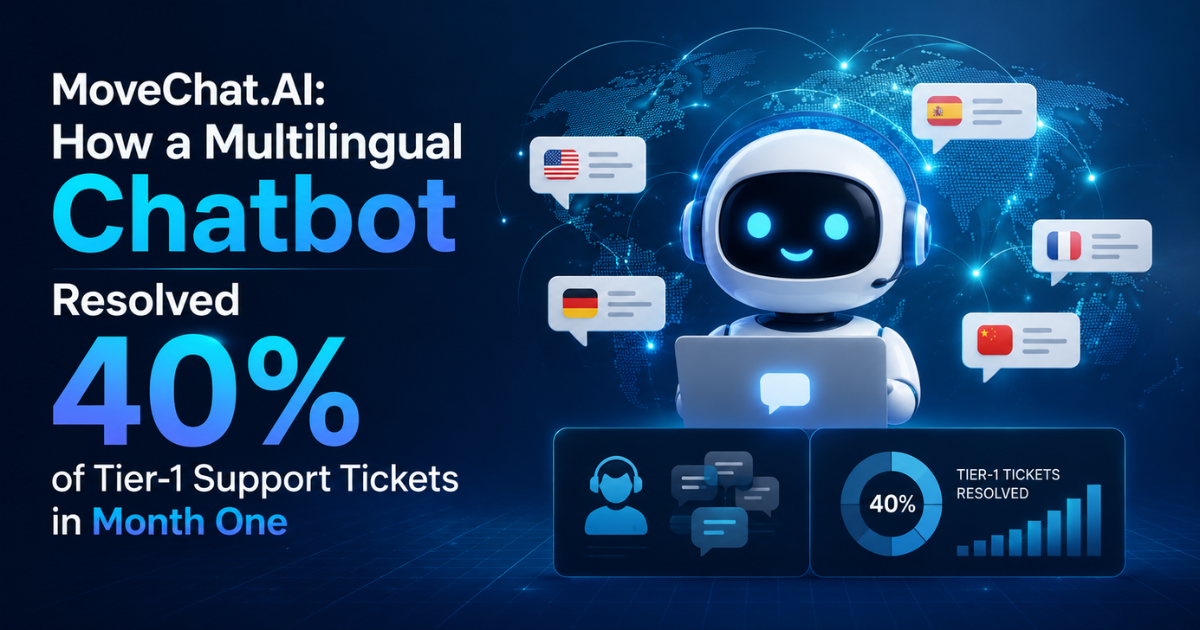
The company decided to test MoveChat.AI, a multilingual AI chatbot built to automate customer support without losing conversation quality. Within the first month, the chatbot resolved 40% of Tier-1 support tickets automatically.
This case study explains how the implementation worked, what results were achieved, and why multilingual AI support is becoming essential for SaaS businesses worldwide.
The Support Challenge at GlobalLogistics
GlobalLogistics operates across multiple regions and supports customers in different languages. Their SaaS platform helps businesses manage shipping, tracking, and warehouse operations.
As customer growth accelerated, support demand increased quickly. Most incoming tickets were repetitive Tier-1 requests. These included password resets, shipment status questions, billing requests, and onboarding issues.
The support team faced several problems:
- Long first response times
- High ticket backlog
- Rising operational costs
- Language barriers during support conversations
- Agent burnout caused by repetitive tasks
According to a report by Zendesk, over 70% of customers expect conversational support experiences. Businesses that fail to provide fast responses risk losing customer trust.
GlobalLogistics needed a scalable support solution that could reduce workload without harming customer experience.
Why Traditional Support Workflows Failed
The company initially attempted to solve the problem by expanding the support team. However, scaling human operations alone created new issues. Training new agents required time. Maintaining quality across multiple languages became difficult. Night shift support increased operational costs further.
The CTO explained that the company noticed a major inefficiency pattern. Nearly half of all incoming tickets followed predictable formats.
Examples included:
- "Where is my shipment?"
- "How do I reset my password?"
- "How can I update billing information?"
- "Why is my dashboard not syncing?"
Human agents spent hours answering repetitive questions.
Research from Gartner predicts that conversational AI will reduce contact center labor costs significantly over the next few years. GlobalLogistics realized that automation was no longer optional.
The company began searching for an AI-powered multilingual support solution.
Why GlobalLogistics Chose MoveChat.AI
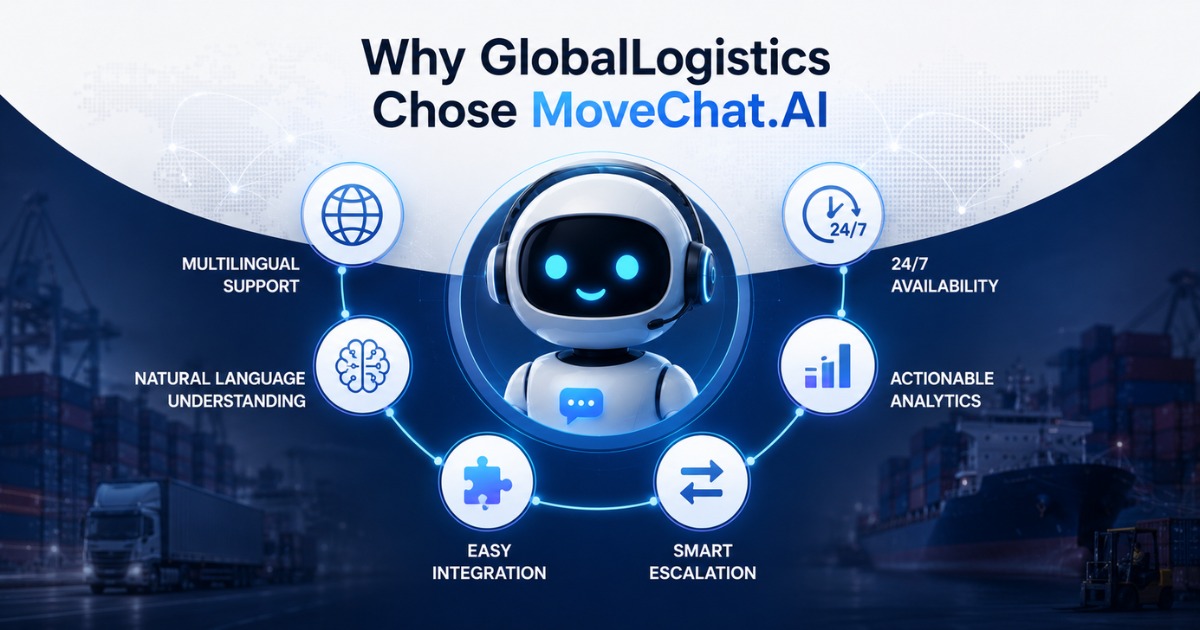
GlobalLogistics evaluated several chatbot platforms before selecting MoveChat.AI. The company wanted more than a simple scripted chatbot. They needed a system capable of understanding customer intent across multiple languages.
Several factors influenced the decision.
Natural Language Understanding
MoveChat.AI could understand customer intent instead of relying only on keyword matching. This improved conversation quality immediately.
Multilingual Support
The chatbot supported multiple languages without requiring separate workflows. This helped GlobalLogistics serve customers across different regions consistently.
Easy SaaS Integration
The platform integrated smoothly with CRM systems, helpdesk platforms, internal knowledge bases, and ticket routing systems.
Human Escalation Logic
Complex requests automatically moved to human agents when necessary. This prevented customer frustration during advanced support cases.
For companies exploring conversational AI adoption, Movenetics Digital also offers:
- AI Workflow Automation Services
- Custom SaaS Development Solutions
- Enterprise AI Integration Consulting
GlobalLogistics also appreciated the implementation speed. The first production version launched within weeks.
How MoveChat.AI Was Implemented
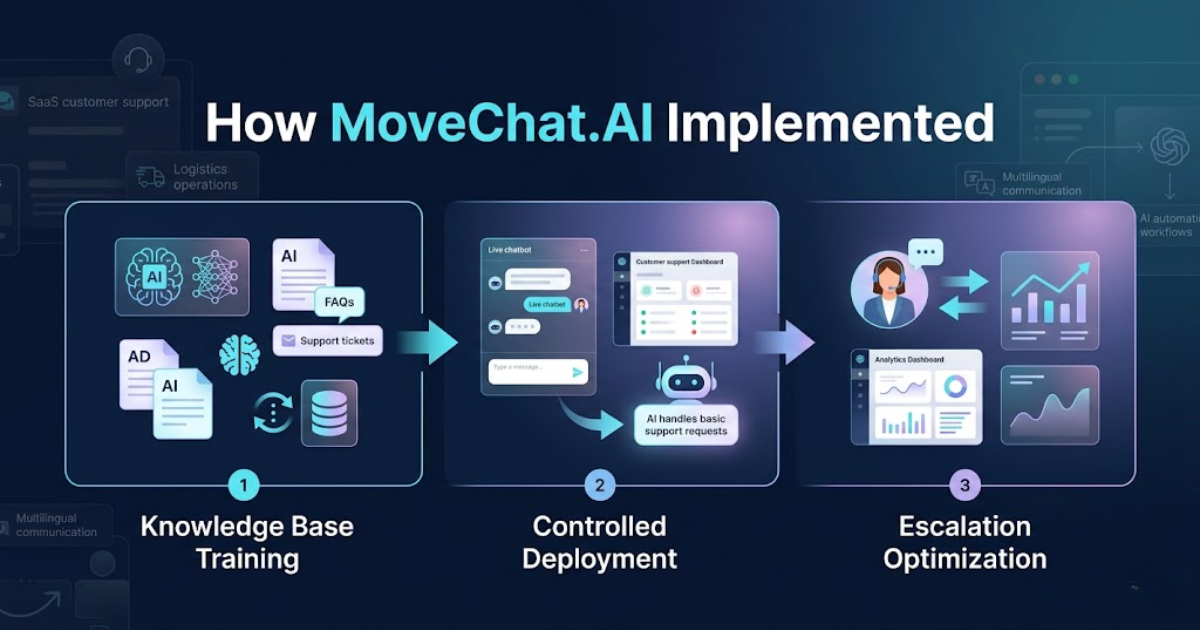
The implementation process focused on reducing friction for both customers and support teams. The rollout happened in phases instead of a full replacement approach. This reduced operational risk and allowed the support team to monitor performance carefully.
"Phase by phase. Not all at once. That's how great automation gets built."
Phase 1: Knowledge Base Training
The AI system was trained using existing support documentation, historical support tickets, FAQ databases, and internal troubleshooting workflows. This helped the chatbot learn real customer issues quickly.
Phase 2: Controlled Deployment
The chatbot initially handled low-risk Tier-1 requests only — password support, shipment tracking, account verification, and basic onboarding help.
Phase 3: Escalation Optimization
The company refined escalation triggers after monitoring conversation quality. Support managers reviewed failed conversations, escalation accuracy, customer satisfaction scores, and response speed.
The Multilingual Support Advantage
One of the biggest breakthroughs came from multilingual automation. Before MoveChat.AI, non-English tickets often waited longer for resolution. Specialized language agents were limited. This created uneven customer experiences across regions.
MoveChat.AI changed that quickly. The chatbot supported customers in their preferred language during the first interaction itself.
Benefits included:
- Faster ticket resolution
- Better customer satisfaction
- Reduced translation dependency
- More consistent support quality
According to CSA Research, customers are far more likely to purchase and engage with businesses that support their native language. For GlobalLogistics, multilingual support directly improved customer trust.
Results After the First Month
The first month produced measurable operational improvements. The most important result was clear: 40% of Tier-1 support tickets were resolved automatically. This significantly reduced pressure on human agents.
| Metric | Before MoveChat.AI | After Month One |
|---|---|---|
| Tier-1 Ticket Resolution | Fully Manual | 40% Automated |
| Average First Response Time | 18 Minutes | Under 2 Minutes |
| Ticket Backlog | High | Reduced |
| Language Coverage | Limited | Expanded |
| Agent Workload | Heavy | Reduced |
The support team could now focus on higher-value customer issues instead of repetitive requests. The company also noticed improved onboarding experiences for new customers.
Key Features That Improved Support Efficiency
Several features contributed directly to the results achieved by MoveChat.AI.
| Feature | How It Helped |
|---|---|
| AI Intent Recognition | Understood customer questions even when phrasing varied — improved response accuracy significantly |
| Smart Escalation | Complicated cases transferred to human agents with full conversation context attached — customers never had to repeat themselves |
| 24/7 Availability | Customers received immediate support outside business hours, especially valuable for international operations |
| Knowledge Base Sync | Continuously synced with updated support documentation — kept responses accurate without manual retraining |
| Analytics Dashboard | Support leaders gained visibility into ticket categories, escalation rates, satisfaction trends, and resolution performance |
Customer Feedback and CTO Insights
The CTO of GlobalLogistics described the deployment as one of the company's most impactful operational upgrades. One major observation stood out immediately: customers did not resist AI support when conversations were helpful and fast.
Instead, users appreciated:
- Instant replies
- Consistent answers
- Language flexibility
- Faster issue resolution
The support team also reported better morale. Agents spent less time on repetitive tasks and more time solving meaningful customer problems.
| Stakeholder | Main Feedback |
|---|---|
| Customers | Faster responses and better accessibility |
| Support Agents | Reduced repetitive workload |
| Support Managers | Improved ticket visibility |
| CTO Team | Lower operational pressure |
| Business Leadership | Better scalability potential |
This created strong internal support for expanding AI automation further.
Lessons for SaaS Customer Support Teams
This case study highlights several important lessons for SaaS businesses.
Automation Works Best for Repetitive Work
AI chatbots are highly effective for predictable support requests. Teams should identify repetitive workflows first before expanding automation scope.
Multilingual Support Matters
Global products require global support experiences. Customers expect businesses to communicate clearly in their preferred language.
AI Should Support Humans, Not Replace Them
MoveChat.AI succeeded because it combined automation with intelligent escalation. Human agents remained critical for complex situations.
Analytics Are Essential
Support automation improves faster when teams monitor conversation quality, escalation accuracy, customer satisfaction, and failed interactions. Continuous optimization drives better long-term results.
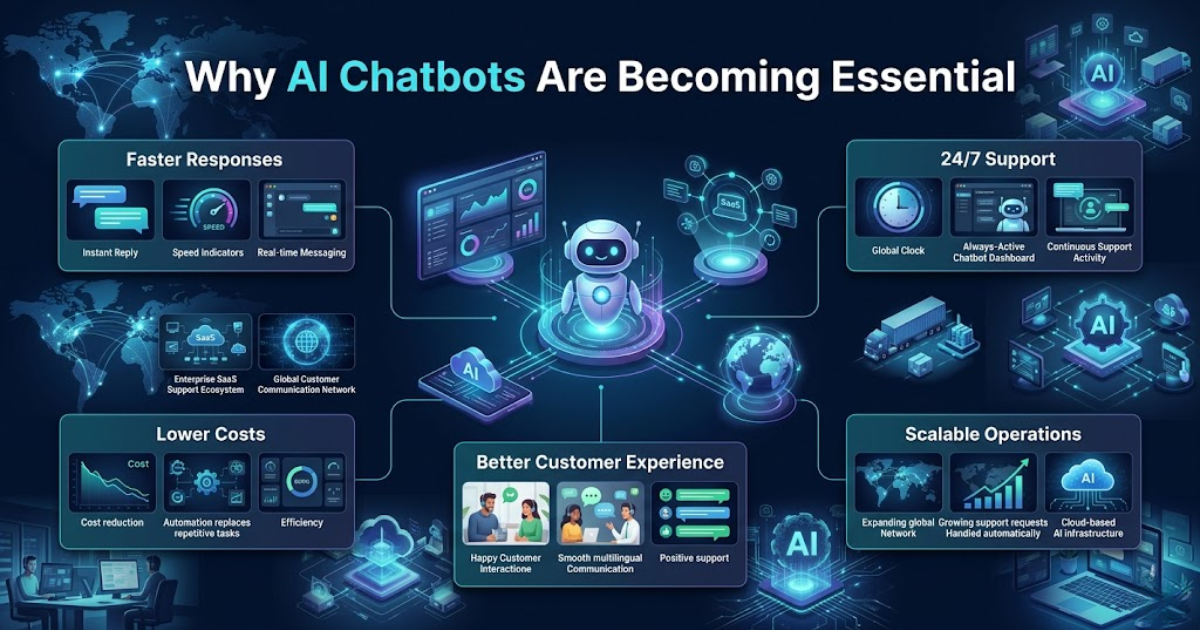
Why AI Chatbots Are Becoming Essential
The customer support landscape is changing rapidly. Modern users expect instant answers across every digital channel. At the same time, support teams face rising costs and growing ticket volumes. This is why many SaaS companies are investing heavily in conversational AI platforms.
"Multilingual AI support is no longer experimental — it is a competitive advantage."
According to McKinsey & Company, generative AI and automation technologies can significantly improve customer care productivity. Businesses that adopt AI strategically can achieve faster response times, lower support costs, better scalability, and improved customer experiences.
Businesses that adopt AI strategically can achieve:
- Faster response times
- Lower support costs
- Better scalability
- Improved customer experiences
- Higher support consistency
For growing SaaS companies, multilingual AI support is becoming a competitive advantage instead of an experimental technology.
Conclusion
GlobalLogistics achieved meaningful results within the first month of deploying MoveChat.AI. The platform resolved 40% of Tier-1 support tickets automatically while improving customer experience across multiple languages.
Instead of overwhelming support agents with repetitive tasks, the company created a scalable hybrid support model powered by AI automation and human expertise.
For SaaS businesses facing rising support volumes, this case study demonstrates a practical path toward smarter customer operations. If your support team struggles with repetitive tickets, slow responses, or multilingual challenges, now is the right time to explore conversational AI solutions.
Ready to transform your customer support operations?
Visit Movenetics Digital to learn how MoveChat.AI can help your team resolve more tickets, faster — in any language.
Explore MoveChat.AIFrequently Asked Questions
MoveChat.AI is a multilingual AI chatbot designed to automate customer support workflows. It helps businesses resolve repetitive Tier-1 support queries, reduce response times, improve customer satisfaction, and lower support costs through intelligent automation.
The chatbot was trained on support documentation, historical tickets, FAQs, and troubleshooting workflows. By understanding customer intent and automating common requests such as password resets, shipment tracking, and billing inquiries, it successfully resolved 40% of Tier-1 tickets without human intervention.
Multilingual AI chatbots provide instant support in multiple languages, reduce language barriers, improve customer experience, increase ticket resolution speed, and help SaaS companies deliver consistent support across global markets.
No. MoveChat.AI is designed to handle repetitive and predictable support requests while automatically escalating complex issues to human agents. This hybrid approach improves efficiency without compromising customer experience.
Yes. MoveChat.AI is particularly valuable for growth-stage businesses and SaaS companies that experience increasing support volumes. It helps teams scale customer support operations efficiently without significantly increasing staffing costs.