
Every CTO has heard the promise. A fast AI proof of concept. A demo in two weeks. A model that predicts, automates, or personalizes everything. Then reality hits. The pilot works in a controlled environment but collapses during production deployment. Teams face broken pipelines, inconsistent outputs, rising infrastructure costs, and security concerns. Stakeholders lose confidence before the system delivers measurable value.
According to Gartner, most AI projects never move beyond pilot stages because organizations underestimate operational complexity.
This is not usually a model problem. It is an engineering problem.
At Movenetics Digital, we have seen companies invest heavily in AI experimentation while ignoring the engineering foundations required for reliable deployment. The result is predictable. Great demos fail to become scalable products.
This article explains why most AI pilots fail before production and the engineering practices that prevent those failures.
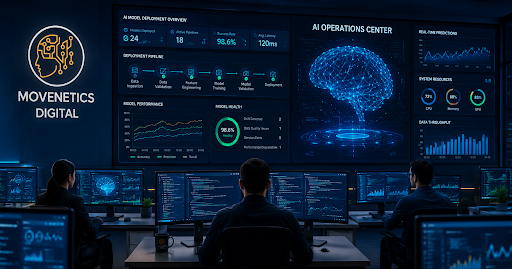
The AI Pilots Collapse Before Production
AI pilots often succeed in isolated environments because the conditions are controlled. Production environments are different.
Real-world systems contain inconsistent data, legacy infrastructure, compliance requirements, unpredictable user behavior, and operational pressure. A pilot that works in a notebook rarely survives these conditions without proper engineering. Here are the most common reasons AI pilots fail.
Here are the most common reasons AI pilots fail.
Poor Data Quality
AI systems depend on reliable data pipelines. Most organizations discover too late that their data is fragmented across tools, outdated, duplicated, or incomplete. A model trained on inconsistent data produces inconsistent predictions.
According to IBM Research, poor data quality costs businesses trillions globally every year.
Common data problems include:
- Missing values
- Inconsistent formats
- Delayed ingestion
- Duplicate records
- Lack of labeling standards
- No data validation pipelines
Without strong data engineering, even advanced models become unreliable.
No Clear Production Architecture
Many AI pilots begin without production planning. Teams focus entirely on model accuracy while ignoring:
- Infrastructure scalability
- API reliability
- Security
- Monitoring
- Deployment workflows
- Failover systems
As usage grows, systems become unstable. Production AI requires architecture decisions from day one.
This is why scalable organizations invest in engineering standards before scaling experimentation.
For teams planning enterprise AI infrastructure, our approach to scalable platform design in custom systems becomes critical:
Custom Software Development ServicesLack of MLOps Processes
Traditional software deployment practices are not enough for AI systems. Machine learning introduces additional operational challenges:
- Model drift
- Dataset versioning
- Retraining workflows
- Experiment tracking
- Feature management
- Continuous monitoring
Without MLOps, teams cannot maintain consistent performance after deployment.
According to Google Cloud AI Architecture Best Practices, operational maturity is one of the biggest factors separating successful AI deployments from failed experiments.
Misaligned Business Goals
Some AI pilots begin because leadership wants to "use AI" without defining measurable outcomes. This creates dangerous ambiguity. Teams optimize models without understanding:
- Revenue impact
- Operational KPIs
- User adoption metrics
- Cost reduction targets
- Workflow improvements
Successful AI systems solve operational problems, not just technical challenges. Without measurable goals, pilots lose executive support quickly.
Engineering Practices That Prevent AI Failure
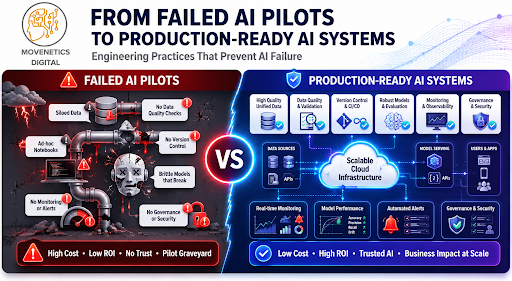
The organizations that deploy AI successfully follow disciplined engineering practices. They treat AI as production software, not experimentation. Here are the practices that matter most.
Build Data Pipelines Before Models
Reliable AI begins with reliable data. Strong data engineering includes:
- Automated ETL pipelines
- Validation checks
- Centralized storage
- Schema consistency
- Data lineage tracking
- Real-time monitoring
Engineering teams should prioritize observability before optimization. At Movenetics Digital, we often advise clients to invest in data infrastructure before advanced model development. This reduces long-term deployment risk significantly.
Organizations scaling AI systems should also prioritize robust analytics workflows and infrastructure automation:
Data Engineering and MLOps Services
Design for Production Early
Production readiness should shape architecture decisions from the beginning. That includes:
- Containerized deployments
- Scalable cloud infrastructure
- API-first architecture
- Security compliance
- Observability layers
- Infrastructure as code
AI systems fail when prototypes become accidental production environments. Teams should separate experimentation environments from deployment infrastructure immediately.
Create Monitoring Systems
Monitoring is not optional in AI systems. Models degrade over time because user behavior, data patterns, and operational environments change continuously. Production monitoring should track:
- Prediction accuracy
- Latency
- Drift detection
- Infrastructure health
- User feedback
- Failure rates
Without monitoring, organizations cannot detect performance decline early enough.
Use Cross-Functional Engineering Teams
Successful AI deployment requires collaboration across:
- Data engineers
- Backend developers
- DevOps engineers
- ML engineers
- Product teams
- Security specialists
AI projects fail when ownership exists only within isolated data science teams. Production systems require operational accountability.
Why Data Engineering Matters More Than Models
Many companies overestimate the importance of model sophistication. In reality, infrastructure quality often matters more than algorithm complexity.
This is why modern AI organizations invest heavily in:
- Distributed data systems
- Streaming infrastructure
- Feature stores
- Workflow orchestration
- Real-time analytics pipelines
According to Databricks Research, reliable data operations remain one of the strongest predictors of successful enterprise AI adoption. The companies winning with AI are operationally disciplined. They focus on reliability first.
Engineering Standards Reduce Long-Term Risk
Strong engineering standards create predictable systems. That means:
- Fewer deployment failures
- Easier debugging
- Faster scaling
- Better governance
- Lower infrastructure waste
This operational consistency becomes critical as AI workloads expand across departments. At Movenetics Digital, engineering standards are integrated into every AI engagement from architecture planning to deployment workflows.
MLOps Is the Missing Layer
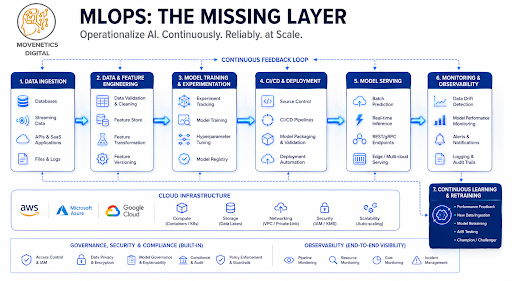
Most organizations understand DevOps. Fewer understand MLOps. MLOps extends operational discipline into machine learning systems. It creates repeatable processes for:
- Model deployment
- Version control
- Retraining
- Monitoring
- Governance
- Compliance
Without MLOps, AI systems become impossible to maintain at scale.
Core Components of a Mature MLOps Stack
A production-grade MLOps environment usually includes:
| Component | Purpose |
|---|---|
| Model Registry | Tracks deployed versions |
| CI/CD Pipelines | Automates deployment |
| Monitoring Systems | Detects drift and failures |
| Feature Stores | Maintains data consistency |
| Orchestration Tools | Automates workflows |
| Logging Infrastructure | Enables debugging |
Consistent operational processes reduce deployment risk dramatically.
The Production-Ready AI Architecture CTOs Need
CTOs evaluating AI systems should prioritize architecture readiness over pilot excitement. The right questions include:
- Can the system scale reliably?
- Is the data pipeline stable?
- Can teams monitor drift?
- Are deployments repeatable?
- Is security integrated?
- Are operational costs predictable?
Production AI is an infrastructure challenge as much as a modeling challenge. Organizations that recognize this early move faster with fewer failures.
Signs Your AI System Is Production Ready
A production-ready AI platform usually has:
- Automated testing pipelines
- Version-controlled datasets
- Infrastructure monitoring
- Defined rollback procedures
- Secure API layers
- Real-time observability
- Cost tracking systems
Without these systems, scaling becomes extremely risky.
How Movenetics Digital Approaches AI Engineering
At Movenetics Digital, we approach AI systems as engineering ecosystems rather than isolated models.
Our process focuses on:
- Production-first architecture
- Scalable data pipelines
- MLOps integration
- Infrastructure automation
- Monitoring and observability
- Security-focused deployment
This approach helps organizations move beyond fragile pilots toward scalable AI systems that deliver measurable business outcomes.
Our engineering teams work closely with CTOs and product leaders to align infrastructure decisions with long-term operational goals. That alignment is what transforms AI experimentation into sustainable business capability.
Final Thoughts
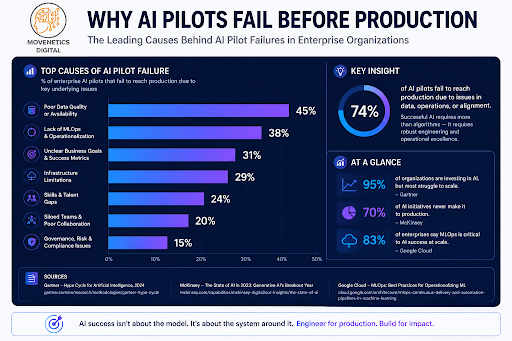
Most AI pilots fail because organizations underestimate operational complexity. The challenge is rarely model intelligence. The challenge is engineering maturity.
Companies that succeed with AI build strong foundations before scaling experimentation. They prioritize infrastructure, data quality, observability, deployment workflows, and MLOps practices from the beginning.
That is how AI systems survive beyond the demo stage.
If your organization is exploring AI implementation, now is the time to evaluate whether your infrastructure is truly production-ready.
Sources: Gartner (2024), McKinsey AI Report, Google Cloud MLOps Documentation, Deloitte AI Research, IBM AI Enterprise Studies.
Ready to move beyond AI prototypes?
Connect with Movenetics Digital to discuss your AI architecture, data engineering, and MLOps strategy. Build AI systems that scale with confidence.
Book a Scoping CallFrequently Asked Questions
Most AI pilots fail because organizations focus heavily on model development while neglecting data engineering, infrastructure, monitoring, security, and deployment processes. Production AI requires operational maturity beyond building an accurate model.
The biggest challenge is managing operational complexity. This includes maintaining data quality, monitoring model performance, handling model drift, ensuring scalability, and integrating AI systems with existing business infrastructure.
MLOps provides structured processes for model deployment, version control, monitoring, retraining, and governance. It helps organizations maintain AI systems reliably and scale them efficiently in production environments.
Even highly advanced AI models will perform poorly if they rely on inconsistent or low-quality data. Strong data pipelines, validation processes, and data governance often have a greater impact on AI success than model sophistication alone.
A production-ready AI system typically includes automated testing, version-controlled datasets, monitoring and observability tools, secure APIs, rollback mechanisms, scalable infrastructure, and cost-tracking processes to ensure reliable long-term operation.