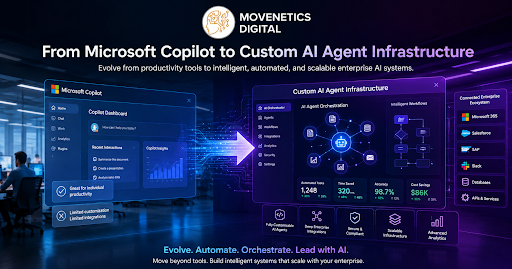
Microsoft Copilot has accelerated AI adoption across enterprise teams. Many organizations start with Copilot because it integrates directly into existing Microsoft workflows. Teams can generate emails, summarize meetings, automate documents, and improve productivity quickly. That initial value is real. However, many businesses eventually reach a limit. Operations teams begin asking for AI systems that can access internal workflows, automate operational decisions, connect multiple business systems, execute actions automatically, handle industry-specific tasks, and operate across departments. This is where the shift toward a custom AI agent begins.
At Movenetics Digital, we often work with organizations that started with Copilot but later required more advanced automation and operational intelligence.
According to Microsoft Copilot Documentation, Copilot is designed primarily as a productivity assistant rather than a fully customized operational AI platform.
What Microsoft Copilot Does Well
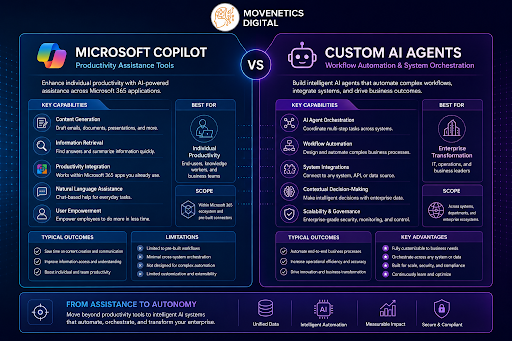
Copilot solves many productivity problems effectively. For most organizations, it delivers immediate operational improvements with minimal implementation effort.
Core Strengths of Microsoft Copilot
Productivity Enhancement
Copilot helps employees work faster inside Microsoft tools. Examples include:
- Document drafting
- Meeting summaries
- Email assistance
- Spreadsheet analysis
- Presentation generation
This improves day-to-day efficiency quickly.
Fast Enterprise Adoption
Organizations already using Microsoft ecosystems can deploy Copilot rapidly. That reduces onboarding complexity. It also lowers infrastructure friction.
Secure Enterprise Environment
Microsoft provides enterprise-grade security controls and compliance standards. This matters for regulated industries.
According to Gartner AI Workplace Research, productivity-focused AI assistants continue to accelerate enterprise adoption because they reduce workflow friction.
The Limitations of General AI Assistants
Copilot works well for general productivity tasks. However, operational complexity creates limitations over time.
Limited Workflow Automation
Copilot assists users. Custom AI agents execute workflows. That difference becomes critical for operational teams.
For example, Copilot may summarize support tickets. A custom AI agent can:
- Prioritize tickets
- Trigger workflows
- Update systems
- Notify departments
- Escalate incidents automatically
The operational depth is significantly different.
Restricted System Integration
Enterprise operations often require AI systems that interact with:
- ERP platforms
- CRM systems
- Internal databases
- Logistics tools
- Finance software
- Support platforms
General assistants cannot always support deep operational orchestration. Custom AI agents are designed for that purpose.
Limited Industry Context
Generic AI assistants often lack industry-specific logic. For example:
- Logistics workflows
- Healthcare compliance
- Financial risk analysis
- Manufacturing operations
Custom AI agents can be trained around operational context and business logic. That improves reliability dramatically.
When a Custom AI Agent Makes Sense
Not every organization needs a custom AI agent immediately. However, certain operational signals indicate it may be time to upgrade.
Your Teams Need Multi-System Automation
AI agents become valuable when workflows cross multiple systems. Examples include:
- Sales workflows
- Customer onboarding
- IT operations
- Logistics coordination
- Financial approvals
AI agents can execute actions across platforms automatically. That reduces operational bottlenecks.
You Need Persistent Operational Memory
Custom AI agents can maintain long-term contextual memory. This helps with:
- Customer histories
- Operational workflows
- Process continuity
- Internal documentation
- Decision tracking
Persistent memory improves automation quality significantly.
Your Business Requires Custom Logic
Every organization has unique operational rules. Examples include:
- Approval hierarchies
- Compliance workflows
- Industry regulations
- Risk management procedures
Custom AI agents adapt to these requirements directly.
You Need Autonomous Operations
Many companies eventually move from AI assistance to AI execution. That includes:
- Automated triage systems
- Workflow routing
- Intelligent scheduling
- Internal task execution
- AI-powered operational monitoring
According to McKinsey Generative AI Research, organizations adopting advanced AI automation can unlock major productivity gains across operations.
What the Migration Process Looks Like
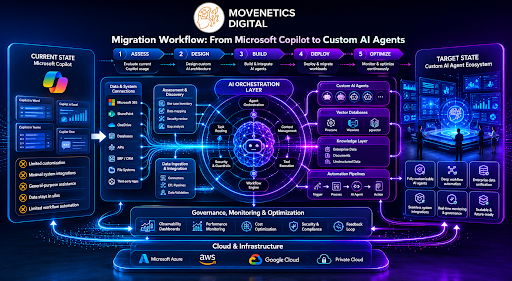
Migrating from Copilot to a custom AI agent should happen in stages. Successful organizations avoid rebuilding everything at once.
Stage 1: Workflow Assessment
The first step identifies repetitive operational workflows. Teams evaluate:
- Existing automation gaps
- Manual bottlenecks
- High-volume processes
- Data availability
- System dependencies
This creates migration clarity.
Stage 2: Data and System Integration
AI agents require secure access to operational systems. This often includes:
- APIs
- Databases
- Internal documents
- Workflow tools
- Business platforms
Integration quality determines long-term AI performance.
Stage 3: AI Agent Design
The AI system is then structured around operational goals. This includes:
- Memory architecture
- Tool usage permissions
- Retrieval systems
- Workflow orchestration
- Monitoring systems
The goal is operational reliability.
Stage 4: Controlled Deployment
Successful organizations deploy AI agents gradually. Common rollout phases include:
| Phase | Objective |
|---|---|
| Pilot Testing | Validate workflows |
| Limited Team Rollout | Reduce operational risk |
| Monitoring Phase | Track reliability |
| Full Deployment | Scale automation |
| Optimization | Improve performance |
Controlled deployment prevents operational disruption.
The Technical Stack Behind AI Agents
Custom AI agents rely on a broader technical stack than productivity assistants.
Core Components of an AI Agent Platform
| Component | Purpose |
|---|---|
| LLM Layer | Language understanding |
| Vector Database | Context retrieval |
| Workflow Engine | Process execution |
| API Integrations | System communication |
| Memory Layer | Context persistence |
| Monitoring Systems | Reliability tracking |
These components work together to support autonomous operations.
Why Infrastructure Matters
AI agents often operate continuously. That requires scalable infrastructure capable of:
- Real-time processing
- Security enforcement
- High availability
- Workflow orchestration
- Monitoring and logging
Weak infrastructure creates unreliable automation. At Movenetics Digital, we design AI agent systems with production-grade engineering standards from the start.
Organizations evaluating enterprise automation often benefit from: AI Agents and Automation Solutions
Teams exploring productivity ecosystem integrations can also review: Microsoft Copilot Integration Services
Companies scaling AI operations frequently require deeper orchestration support through: Generative AI Development Services
Common Mistakes During AI Migration
Many organizations underestimate operational complexity during migration. That creates unnecessary deployment risks.
Trying to Replace Everything Immediately
AI migration should happen incrementally. Replacing entire operational systems at once increases failure risk significantly.
Ignoring Governance
AI agents require strong governance controls. That includes:
- Permission management
- Audit logging
- Human oversight
- Compliance monitoring
Without governance, automation risk increases quickly.
Underestimating Change Management
Employees need clear operational guidance. AI adoption improves when teams understand:
- Workflow changes
- Operational responsibilities
- Escalation paths
- AI limitations
Training matters as much as technology.
How Movenetics Digital Builds AI Agents
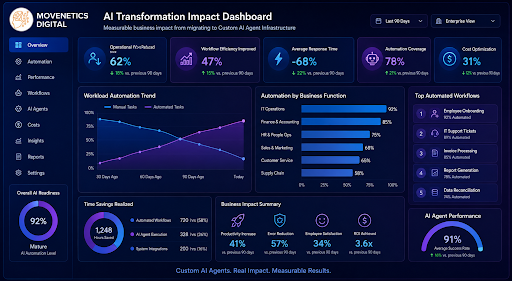
At Movenetics Digital, we help organizations move beyond basic AI assistance toward scalable operational automation.
Our engineering approach focuses on:
- Enterprise AI architecture
- Workflow orchestration
- Secure system integration
- Operational reliability
- Scalable automation pipelines
- Production-grade monitoring
We build AI systems designed for long-term operational performance. That allows organizations to automate workflows confidently while maintaining governance and security.
Our teams work closely with IT leaders and operational stakeholders throughout migration planning and deployment.
Final Thoughts
Microsoft Copilot is an excellent starting point for enterprise AI adoption. However, many organizations eventually require deeper operational automation and workflow intelligence. That transition often leads toward custom AI agents.
The migration process should focus on operational goals, system integration, governance, and scalable infrastructure. Organizations that approach AI strategically will gain long-term operational advantages.
Ready to build operational AI systems?
Connect with Movenetics Digital to discuss AI agent architecture, workflow automation, and enterprise AI integration. Build AI systems designed for real operational impact.
Book a Scoping CallFrequently Asked Questions
Microsoft Copilot is designed primarily as a productivity assistant for tasks like document creation, email drafting, meeting summaries, and data analysis. As businesses grow, they often need AI systems that can automate workflows, integrate with multiple business applications, make operational decisions, and execute tasks autonomously — capabilities that custom AI agents are built to provide.
Microsoft Copilot helps users perform tasks more efficiently within Microsoft applications. A custom AI agent goes beyond assistance by connecting with business systems, maintaining context, automating workflows, executing actions, and supporting industry-specific operational processes across departments.
A business should consider a custom AI agent when it needs multi-system automation, persistent operational memory, custom business logic, workflow orchestration, autonomous task execution, or deeper integrations with CRMs, ERPs, databases, and other enterprise systems.
Yes. Custom AI agents can integrate with a wide range of business platforms, including CRM systems, ERP software, internal databases, customer support tools, finance applications, logistics platforms, and proprietary enterprise systems through APIs and secure integrations.
Custom AI agents help organizations automate complex workflows, improve operational efficiency, reduce manual work, support intelligent decision-making, maintain business-specific knowledge, enhance scalability, and create long-term competitive advantages through tailored AI-driven automation.