Growth-stage businesses move fast. Operations become more complex every quarter. Teams handle more tools, more customer requests, and larger volumes of data. Many companies first turn to Robotic Process Automation to reduce manual work and improve efficiency. However, modern business workflows now require more than task automation. Operations leaders need systems that can reason, adapt, analyze context, and make decisions in real time. That is where AI agents are changing the game.
According to McKinsey & Company, companies using AI-driven automation can improve productivity significantly across operations and customer workflows. Meanwhile, Gartner predicts that agentic AI will become one of the most transformative technologies for enterprise operations in the coming years.
For growth-stage businesses, the question is no longer whether automation matters. The real question is whether traditional RPA can support future growth without intelligent decision-making capabilities.
This blog compares AI agents and RPA in detail. It explains where RPA still works, where it fails, and why growth-stage businesses are now adopting agentic automation strategies.
What Is Robotic Process Automation?
RPA uses software bots to automate repetitive and rule-based tasks. These bots follow predefined instructions and workflows. Businesses commonly use RPA for tasks such as invoice processing, report generation, data entry, and CRM updates.
Traditional RPA works best when workflows stay predictable. The system depends heavily on structured inputs and fixed rules. If the process changes, the bot often breaks and requires manual updates.
Common RPA use cases include:
- Copying data between systems
- Automating payroll tasks
- Processing invoices
- Updating spreadsheets
- Handling repetitive back-office operations
Platforms like UiPath and Automation Anywhere helped businesses automate operations at scale over the last decade. RPA delivers value when tasks remain stable. However, modern operations rarely stay static for long periods.
What Are AI Agents?
AI agents are intelligent systems that can perform tasks, analyze information, make decisions, and adapt based on changing inputs. Unlike traditional automation tools, AI agents do not rely only on fixed rules.
They combine technologies such as machine learning, natural language processing, memory systems, and reasoning models. This allows them to operate across dynamic environments and complex workflows.
An AI agent can:
- Understand human instructions
- Analyze unstructured data
- Make contextual decisions
- Learn from previous interactions
- Coordinate multiple workflows
- Interact with APIs and software systems
For example, an AI operations agent can review incoming support tickets, identify urgency levels, assign departments, generate responses, and escalate issues automatically.
According to IBM Research, agentic AI systems are becoming essential for enterprise decision automation because they reduce operational dependency on manual oversight.
Growth-stage businesses now require automation systems that can handle ambiguity, not just repetitive patterns.
Why Traditional RPA Is Reaching Its Limits
Many businesses implemented RPA expecting long-term scalability. Initially, the results looked promising. Operational costs decreased, and repetitive tasks became faster. However, scaling RPA introduces new operational challenges.
RPA struggles when workflows involve:
- Unstructured documents
- Human conversations
- Changing business rules
- Cross-platform decision-making
- Real-time customer interactions
For example, an RPA bot may process invoices correctly until the invoice layout changes slightly. A human must then intervene and reconfigure the workflow. Growth-stage companies face constant operational changes. New tools, customer expectations, and market conditions create dynamic environments. Static bots cannot adapt efficiently to these shifts.
| RPA Limitation | Business Impact |
|---|---|
| Rule dependency | High maintenance costs |
| Limited adaptability | Frequent workflow failures |
| No reasoning ability | Human intervention required |
| Weak handling of unstructured data | Delayed operations |
| Poor contextual understanding | Reduced customer experience |
According to Deloitte Insights, many organizations struggle to scale RPA because of maintenance complexity and process fragmentation.
This is why operations leaders are now exploring AI-first automation strategies.
AI Agents vs RPA: Core Differences
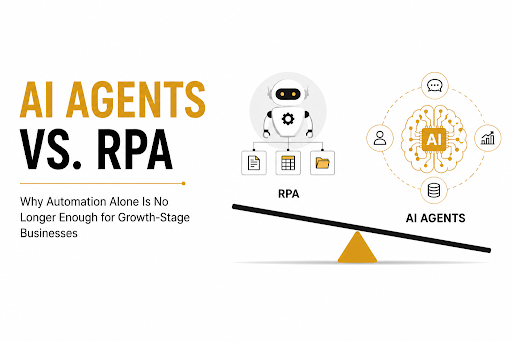
Although both technologies support automation, their capabilities differ significantly. RPA focuses on task execution. AI agents focus on intelligent problem-solving and adaptive workflows.
"RPA automates clicks. AI agents understand intent."
| Feature | RPA | AI Agents |
|---|---|---|
| Workflow Type | Rule-based | Adaptive |
| Decision-Making | Limited | Advanced |
| Data Handling | Structured data only | Structured and unstructured |
| Learning Ability | None | Continuous improvement |
| Human Interaction | Minimal | Conversational and contextual |
| Scalability | Complex maintenance | Flexible expansion |
| Error Handling | Manual correction | Autonomous adaptation |
| Cross-System Intelligence | Limited | High |
AI agents do not simply automate clicks and actions. They understand intent and context before taking action. For operations leaders, this difference changes how teams scale workflows across departments.
Businesses exploring advanced automation often combine AI agents with existing systems rather than replacing infrastructure completely. This hybrid model creates smoother digital transformation journeys.
How AI Agents Improve Business Operations
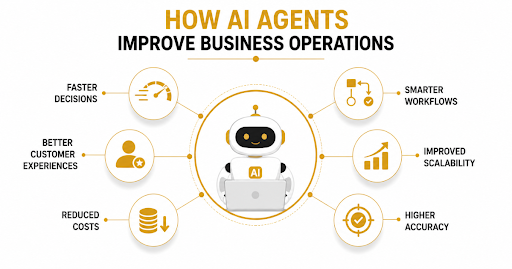
AI agents help businesses move from reactive operations to proactive systems. They improve efficiency while reducing operational bottlenecks. Instead of waiting for humans to guide every workflow, AI agents can analyze situations and take appropriate actions independently.
Faster Decision-Making
AI agents process large datasets quickly. They identify patterns and generate recommendations in real time.
Better Customer Experiences
AI agents personalize interactions based on customer behavior and historical data.
Reduced Operational Costs
Businesses reduce dependency on repetitive manual workflows and improve team productivity.
Smarter Workflow Coordination
AI agents connect tools, systems, and departments without relying on rigid scripting.
Improved Scalability
As operations grow, AI agents adapt faster than traditional automation systems.
According to the PwC Global AI Report, AI-powered automation could contribute trillions to the global economy by improving productivity and operational efficiency.
Growth-stage businesses need systems that scale intelligently, not just mechanically.
Real Use Cases for Growth-Stage Companies
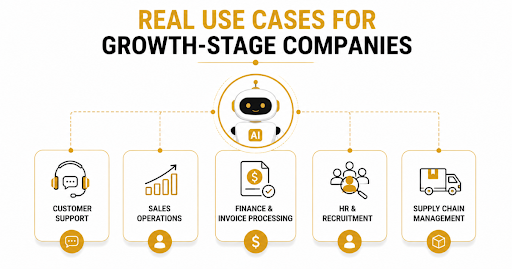
AI agents are already transforming operations across industries. Businesses use them to improve customer service, internal workflows, and decision-making processes.
| Use Case | What AI Agents Do |
|---|---|
| Customer Support Automation | Analyze customer intent, provide contextual responses, escalate complex issues to human teams |
| Sales Operations | Qualify leads, schedule meetings, update CRMs, and prioritize opportunities automatically |
| Finance & Invoice Processing | Extract invoice data, validate records, detect anomalies, and route approvals intelligently |
| HR & Recruitment | Screen resumes, coordinate interviews, and answer employee questions using internal knowledge bases |
| Supply Chain Coordination | Monitor inventory, predict delays, and optimize procurement decisions based on live operational data |
When RPA Still Makes Sense
RPA still provides value in specific situations. Businesses should not remove it entirely from their operations strategy. Simple, repetitive, and highly structured tasks remain ideal for RPA workflows.
Examples include:
- Fixed report generation
- Structured data migration
- Payroll processing
- Compliance logging
- Basic ERP updates
The problem appears when businesses expect RPA to solve complex operational challenges involving reasoning or adaptability. Operations leaders should evaluate workflows carefully before choosing automation technologies.
A practical strategy often involves:
- Using RPA for stable repetitive tasks
- Using AI agents for dynamic workflows
- Integrating both systems where needed
This balanced approach creates operational efficiency without introducing unnecessary complexity.
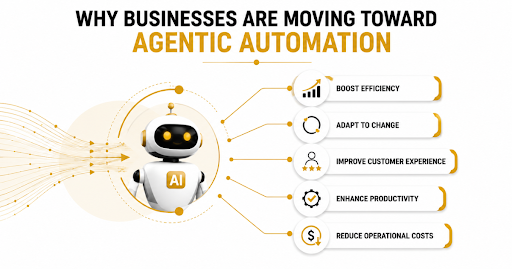
Why Businesses Are Moving Toward Agentic Automation
The business environment has changed dramatically in recent years. Teams manage remote collaboration, multi-platform ecosystems, and growing customer expectations simultaneously. Traditional automation cannot handle this complexity alone.
Agentic automation allows businesses to build systems that:
- Understand business goals
- Execute tasks intelligently
- Adapt to changing inputs
- Collaborate across workflows
- Support long-term scalability
According to Accenture Technology Vision, enterprises adopting AI-driven automation gain competitive advantages through faster innovation and operational resilience.
Growth-stage companies especially benefit because they often lack large operational teams. Intelligent automation helps them scale without increasing overhead aggressively. This shift is not about replacing people. It is about enabling teams to focus on strategic work instead of repetitive operational tasks. Businesses that delay intelligent automation adoption may struggle with operational inefficiencies as they scale.
You can also explore how modern businesses use AI-driven platforms through Movenetics Digital AI Solutions.
How Movenetics Digital Helps Businesses Build AI Agents
At Movenetics Digital, we help growth-stage businesses move beyond basic automation. Our team designs intelligent AI systems that improve operational efficiency, automate decision-making, and support scalable digital transformation strategies.
We help businesses:
- Identify automation gaps
- Evaluate AI readiness
- Build custom AI agents
- Integrate AI workflows with existing systems
- Scale intelligent operations securely
Our approach focuses on business outcomes, not just technology implementation. We understand that operations leaders need practical solutions that deliver measurable value. That is why we combine AI expertise with scalable engineering strategies tailored for modern businesses.
Whether your organization wants smarter customer workflows, AI-powered operations, or intelligent automation infrastructure, our team helps you build systems designed for long-term growth.
Conclusion
RPA changed business automation forever. It reduced repetitive work and improved operational efficiency across industries. However, growth-stage businesses now operate in more complex environments. Static automation alone cannot support modern operational demands. Companies need systems that can think, adapt, and respond intelligently.
AI agents represent the next evolution of enterprise automation. They help operations teams scale faster, reduce friction, improve customer experiences, and make better decisions in real time. Businesses that continue relying only on traditional RPA may face scalability challenges as workflows become increasingly dynamic.
The future belongs to intelligent, adaptive, and agentic automation systems.
Ready to evaluate your business automation strategy?
Explore an AI Readiness Assessment with Movenetics Digital and discover how AI agents can transform your operations for long-term growth.
Explore AI Readiness AssessmentFrequently Asked Questions
RPA automates repetitive, rule-based tasks using predefined workflows. AI agents go further by understanding context, analyzing data, making decisions, and adapting to changing situations without requiring constant manual updates.
Not entirely. RPA remains highly effective for simple, repetitive, and structured processes. AI agents are better suited for complex workflows that require reasoning, decision-making, and handling unstructured data. Many businesses use both technologies together.
Growth-stage companies, startups, SaaS businesses, eCommerce brands, healthcare organizations, financial services firms, and enterprises with complex workflows can benefit significantly from AI agents.
The cost depends on the complexity of the solution. While AI agents may require a higher initial investment than basic automation tools, they often deliver greater long-term ROI through improved productivity, reduced operational costs, and smarter decision-making.
AI agents can understand customer intent, provide personalized responses, resolve common issues automatically, route tickets intelligently, and escalate complex cases to human agents when needed.