
Many AI projects fail before producing measurable business value. The problem is not always the technology. The problem is often the contract structure itself. Many organizations focus heavily on selecting the right technology stack but spend very little time evaluating how project incentives are structured. Even the most capable engineering team can struggle to deliver meaningful business outcomes when contractual expectations are misaligned from the beginning.
Decision makers should remember that contract structures influence project behavior. The way success is defined often determines how teams prioritize resources, timelines, and operational goals throughout the engagement.
Why Traditional AI Contracts Often Fail
Traditional AI contracts usually bill clients based on:
- Hourly engineering time
- Resource allocation
- Long implementation cycles
- Open-ended development scopes
This creates operational misalignment. The vendor gets paid for effort. The client expects measurable business outcomes. Those incentives are not the same.
According to McKinsey AI Business Research, organizations that align AI initiatives with measurable operational objectives generate significantly stronger business results.
At Movenetics Digital, we believe AI engagements should focus on operational outcomes rather than endless implementation hours.
What Are Outcome-Based AI Contracts
Outcome-based AI contracts connect vendor compensation to measurable business impact. This approach creates greater transparency for both parties. Clients gain visibility into expected business outcomes, while vendors understand exactly which operational improvements they are responsible for helping achieve.
As AI investments continue to grow, organizations increasingly prefer models that reduce ambiguity and connect technology spending directly to measurable performance improvements.
Instead of paying only for development hours, organizations define operational targets before implementation begins.
Common Outcome Examples
This approach creates greater transparency for both parties. Clients gain visibility into expected business outcomes, while vendors understand exactly which operational improvements they are responsible for helping achieve.
As AI investments continue to grow, organizations increasingly prefer models that reduce ambiguity and connect technology spending directly to measurable performance improvements.
Outcome-based AI projects often focus on:
- Reducing customer support response time
- Improving workflow efficiency
- Automating operational reporting
- Increasing lead conversion rates
- Reducing manual processing effort
- Improving logistics visibility
The focus shifts from technical activity to business performance.
Why This Model Is Growing
Businesses increasingly want accountability from AI vendors. They no longer want vague implementation promises tied to long delivery cycles. Economic uncertainty has increased pressure on technology leaders to justify every investment. Organizations want clearer evidence that AI initiatives contribute to operational efficiency, revenue growth, or cost reduction.
Outcome-based models provide a framework for demonstrating value more effectively. They help leadership teams evaluate success using business metrics rather than engineering effort.
According to PwC AI Transformation Research, companies prioritizing measurable AI outcomes improve long-term adoption and operational success significantly.
Why Paying for Hours Creates Misalignment
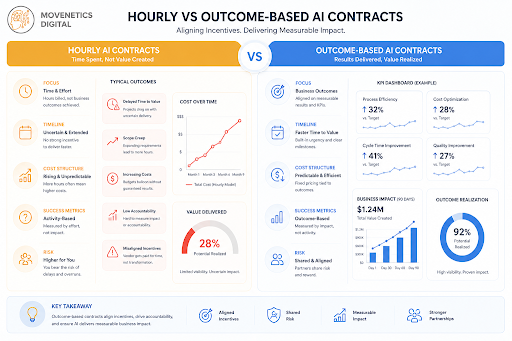
Hourly billing models reward longer implementation timelines. That creates incentive problems.
The Client Wants Speed
Business leaders operate in competitive environments where delays carry real costs. Every month spent waiting for deployment can represent missed revenue opportunities, reduced efficiency, or ongoing operational friction. Organizations benefit most when implementation partners focus on delivering value quickly while maintaining quality and scalability standards.
Most founders and operators want:
- Faster deployment
- Faster ROI
- Lower operational risk
- Clear business visibility
Long projects delay operational value.
The Vendor Often Benefits From Expansion
Not every vendor intentionally expands scope, but many traditional pricing structures create incentives that favor larger projects. Over time, this can increase costs without guaranteeing stronger outcomes. Outcome-focused engagements encourage teams to identify the shortest path to measurable business impact rather than the largest possible implementation effort.
Traditional contracts may encourage:
- Scope expansion
- Additional engineering hours
- Delayed delivery cycles
- Ongoing dependency
This weakens accountability.
Why Operational Metrics Matter More
AI systems should improve operational performance measurably. Operational metrics create objective measures of success. They remove uncertainty and allow both parties to evaluate progress using the same standards throughout the project lifecycle. This shared visibility helps improve communication, stakeholder alignment, and overall confidence in project performance.
Strong AI partnerships focus on:
| Operational Goal | Example KPI |
|---|---|
| Support Efficiency | Faster response time |
| Automation | Reduced manual tasks |
| Sales Productivity | Improved lead conversion |
| Reporting | Faster analytics generation |
| Operations | Reduced process delays |
This creates stronger alignment between client and vendor.
How Outcome Ownership Improves AI Success
Outcome ownership changes how AI projects are managed operationally. The vendor becomes accountable for measurable business impact. Outcome ownership changes project conversations significantly. Teams spend less time discussing completed tasks and more time evaluating whether business objectives are actually being achieved. This shift creates stronger accountability and encourages continuous optimization throughout deployment and post-launch operations.
That improves execution quality.
Teams Prioritize Real Operational Value
Engineering decisions become more strategic when outcomes are the primary focus. Features that do not contribute directly to business performance receive lower priority, reducing unnecessary complexity. As a result, deployments often become more efficient and easier for end users to adopt successfully.
When outcomes matter, engineering teams focus more heavily on:
- Workflow optimization
- User adoption
- Infrastructure stability
- Monitoring systems
- Automation reliability
The project becomes outcome-driven instead of task-driven.
Faster Decision-Making Happens Naturally
Outcome-based engagements encourage operational clarity early. Clear outcome definitions reduce uncertainty during implementation. Stakeholders can evaluate trade-offs more effectively because project priorities are already connected to measurable business goals. This helps teams maintain momentum and avoid delays caused by conflicting expectations or shifting requirements.
That improves:
- Scope definition
- Stakeholder alignment
- Deployment planning
- KPI tracking
This reduces delivery confusion significantly.
Operational Visibility Improves
Visibility becomes especially important during scaling phases. Organizations need accurate information to understand whether AI systems are creating sustained value across departments and workflows. Better reporting and monitoring also help leadership teams identify improvement opportunities earlier and make more informed investment decisions.
Clients gain better visibility into:
- Business progress
- Workflow improvements
- Infrastructure readiness
- Deployment milestones
- ROI performance
Transparency increases trust.
According to IBM AI Consulting Insights, measurable business alignment strongly improves enterprise AI adoption success.
Key Metrics Used in Outcome-Based AI Projects
Strong AI contracts define measurable KPIs clearly before development begins. Metrics create a common language between technical teams and business stakeholders. They ensure discussions remain focused on measurable progress rather than subjective interpretations of success. Without clear measurement frameworks, even successful deployments can struggle to demonstrate their full business value.
That prevents operational ambiguity later.
Common AI Success Metrics
Organizations should avoid tracking too many KPIs at once. A smaller set of meaningful metrics often provides clearer visibility than a large collection of disconnected performance indicators. The most effective metrics are easy to understand, consistently measurable, and closely aligned with strategic business objectives.
Many organizations track:
- Ticket resolution speed
- Workflow automation rates
- Customer response time
- Revenue improvement
- Employee productivity
- Infrastructure uptime
- Cost reduction
Metrics should connect directly to operational goals.
Why Baseline Measurement Matters
Teams should measure current performance before implementation begins. Baseline performance data provides important context for evaluating improvement. Without a starting point, organizations may find it difficult to determine whether AI investments delivered meaningful results. Establishing benchmarks early also helps teams set realistic expectations and prioritize the highest-impact opportunities first.
That establishes:
- Existing operational benchmarks
- Realistic improvement targets
- ROI visibility
- Deployment priorities
Without baseline measurement, success becomes difficult to quantify.
Outcome Metrics Should Stay Practical
Avoid overly complex measurement systems. Complex measurement frameworks often create unnecessary administrative work. Teams spend more time reporting results than improving them. Simple metrics encourage consistent tracking and make it easier for stakeholders to understand the true impact of AI initiatives.
Simple operational metrics usually work best. For example:
- Hours saved weekly
- Reporting time reduction
- Reduced customer wait times
- Faster workflow approvals
Practical metrics improve accountability significantly.
What Founders and COOs Should Evaluate
Leaders should evaluate more than technical capability when selecting AI partners. Business leaders should assess whether potential vendors understand operational challenges beyond technology implementation. Strong partners ask questions about workflows, bottlenecks, and business goals before proposing solutions. This consultative approach often leads to more sustainable results and stronger long-term relationships.
Operational accountability matters equally.
Questions Procurement Teams Should Ask
Procurement decisions should consider accountability as carefully as pricing. The lowest-cost proposal may not generate the highest business value if responsibilities remain unclear. Well-structured discussions early in the process often prevent misunderstandings later during deployment and scaling.
Before signing an AI contract, ask:
- What business outcomes will be measured?
- How is deployment success defined?
- What operational KPIs will improve?
- How will adoption be monitored?
- What infrastructure support is included?
- What happens if timelines shift?
These questions reveal operational maturity quickly.
Strong AI Vendors Focus on Business Impact
Technology expertise remains important, but operational understanding often determines project success. Vendors who understand industry workflows can design solutions that fit naturally into existing business processes. This improves adoption rates and increases the likelihood of achieving measurable outcomes.
Good AI partners discuss:
- Operational workflows
- Process bottlenecks
- User adoption
- Infrastructure scalability
- ROI visibility
Weak vendors focus only on technical features.
Why Outcome Ownership Builds Better Partnerships
Outcome-based contracts encourage long-term operational thinking. Both parties share responsibility for measurable success. Shared accountability encourages collaboration rather than transactional interactions. Both parties remain focused on achieving operational improvements instead of simply completing contractual deliverables. Over time, this creates stronger trust and more productive working relationships.
That improves collaboration significantly.
According to Gartner AI Business Value Research, organizations prioritizing measurable AI outcomes generate stronger operational performance over time.
Risks to Avoid in Outcome-Based AI Agreements
Outcome-based contracts still require careful planning. Outcome-based contracts are powerful, but they require thoughtful planning. Success depends on clearly defined responsibilities, realistic expectations, and measurable objectives. Organizations should treat contract design as an important strategic activity rather than a simple procurement exercise.
Poorly structured agreements create confusion quickly.
Avoid Undefined KPIs
Every operational metric should be measurable clearly. Every stakeholder should understand exactly how success will be measured before implementation begins. Clear definitions reduce confusion and create a stronger foundation for accountability. Consistent measurement also makes progress reporting more accurate and actionable.
Vague goals weaken accountability.
Avoid Unrealistic Timelines
AI deployments involve technical work, operational adjustments, and user adoption efforts. Compressing these activities into unrealistic schedules can compromise quality and increase project risk. Practical timelines improve execution and provide teams with sufficient time to validate performance properly.
AI systems still require:
- Infrastructure setup
- Workflow integration
- User testing
- Monitoring systems
- Operational training
Unrealistic deadlines increase deployment risk.
Avoid Missing Governance Standards
Governance frameworks protect organizations as AI adoption expands. They ensure systems remain secure, transparent, and aligned with regulatory requirements. Strong governance also helps maintain stakeholder confidence as AI becomes more deeply integrated into critical operations.
AI governance should include:
- Data privacy controls
- Monitoring systems
- Human oversight
- Audit visibility
- Infrastructure security
Governance gaps create operational risk later.
Avoid Overly Broad Scope
The best first AI projects focus on one operational problem at a time. Focused projects create faster learning opportunities. Teams can validate assumptions, gather feedback, and demonstrate value before expanding into additional use cases. This incremental approach often produces stronger long-term results than attempting large-scale transformation immediately.
That improves delivery reliability significantly.
How Movenetics Digital Structures AI Engagements
At Movenetics Digital, we structure AI engagements around measurable operational impact. Our methodology emphasizes clarity from the beginning. Every engagement starts with understanding business objectives, operational constraints, and measurable performance indicators before development work begins. This helps ensure AI initiatives remain aligned with organizational priorities throughout implementation and beyond.
Our approach focuses on:
- Clear deployment scope
- Business KPI alignment
- Operational workflow analysis
- Infrastructure readiness
- Governance planning
- Measurable ROI visibility
We believe AI should create measurable operational improvement instead of endless implementation cycles.
Organizations exploring scalable AI implementation often benefit from: Strategic AI Consulting Services
Teams building automation workflows frequently explore: AI Agents and Automation Solutions
Businesses scaling infrastructure and AI operations often require: Cloud and DevOps Services
Final Thoughts
Outcome-based AI contracts create stronger alignment between business goals and technical execution. As AI adoption continues to accelerate, organizations will increasingly evaluate vendors based on measurable business impact rather than technical promises alone. Accountability, transparency, and operational outcomes will become key differentiators.
Companies that embrace outcome-driven approaches today position themselves for stronger returns and more sustainable AI success in the future.
Organizations gain clearer accountability, better ROI visibility, and faster operational learning. The future of enterprise AI will increasingly depend on measurable business outcomes instead of development hours alone. That shift benefits both vendors and clients.
Book a Scoping Call
Planning an AI initiative focused on measurable business impact? Connect with Movenetics Digital for a scoping call focused on operational strategy, deployment planning, and outcome-driven AI implementation. Build AI systems designed around real business results.
Book a Scoping CallFrequently Asked Questions
An outcome-based AI contract is a pricing and delivery model where project success is tied to measurable business results rather than engineering hours or development effort. Examples include reducing operational costs, improving response times, or increasing workflow efficiency.
Outcome-based contracts reduce risk by aligning vendor incentives with business objectives. Both parties focus on achieving defined KPIs, improving accountability, transparency, and ROI visibility throughout the project lifecycle.
Common metrics include customer response time, workflow automation rates, ticket resolution speed, employee productivity improvements, revenue growth, cost reduction, infrastructure uptime, and process efficiency gains.
Not always. Outcome-based contracts work best when business objectives and success metrics can be clearly defined and measured. Organizations should establish realistic KPIs, baseline performance benchmarks, and governance frameworks before implementation begins.
Businesses should look for vendors that prioritize operational outcomes, KPI tracking, governance, user adoption, infrastructure readiness, and long-term business impact rather than focusing solely on technical implementation or development hours.